
Unemployment rates aren’t just statistics, they reflect the state of job opportunities and market conditions worldwide. If you’re curious about how your local job market stacks up against the best and worst employment landscapes globally, this article presents the most accurate data available, sourced directly from the International Monetary Fund (IMF).
Whether you’re considering options abroad, evaluating your local market, or simply interested in global employment trends, this article delivers reliable insights to guide your understanding of today’s job markets in first world countries.
> Table Of Content:
I. The 10 Worst Job Markets in 2026
II. The 10 Best Job Markets in 2026
III. Surprising Major Countries Missing
IV. Table of All Countries Between Best And Worst
I. The 10 Worst Job Markets in 2026
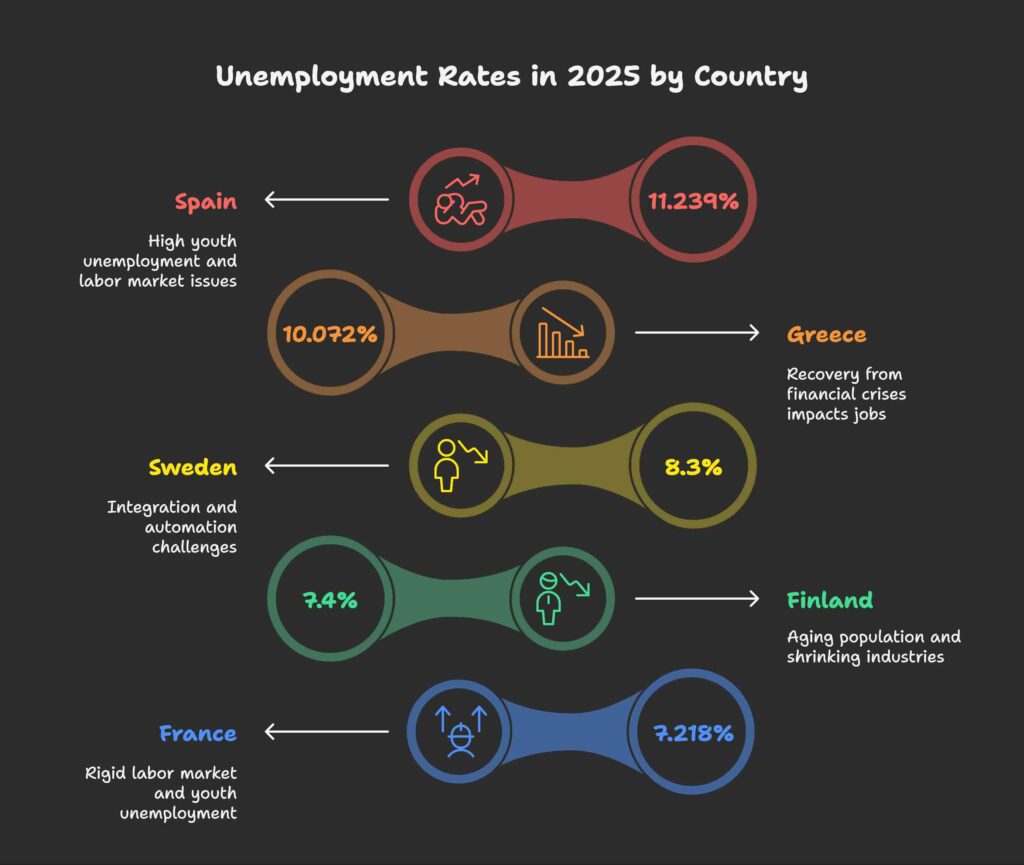
Based on unemployment rates in 2026, these are the 10 countries with the most challenging job markets. The data, sourced from the International Monetary Fund (IMF), highlights significant employment challenges faced by these nations.
1. Spain – 10.7%
Spain’s unemployment is not cyclical anymore, it is embedded in how the labor market functions. Employers still manage risk by limiting long-term commitments, which keeps turnover high and stability low, especially for younger workers. Hiring accelerates when tourism peaks, then cools quickly, creating a pattern of intermittent employment rather than sustained careers. The recent push toward permanent contracts has changed statistics more than underlying behavior, and many workers still experience fragile attachment to the labor force.
2. Finland– 8.7%
Finland faces a quieter issue: jobs exist, but not at the speed or scale needed to absorb a highly qualified population. Companies recruit narrowly, prioritizing exact skill alignment, which leaves a portion of the workforce waiting longer than expected despite strong credentials. Outside major cities, opportunities thin out quickly. The result is a labor market where employment is available, but access is selective and often slow, particularly during transitions between roles.
3. Sweden – 8.4%
While its welfare system remains one of the best globally, Sweden’s numbers reflect a gap between participation and absorption. The system encourages people to enter the labor force, but the private sector does not expand fast enough to integrate everyone evenly. Employers tend to hire cautiously, favoring candidates who already meet strict requirements, which leaves newer entrants and foreign-born workers on the margins. The economy is stable, but access to it is not equally distributed.

4. Greece – 8.4%
Greece has moved past crisis conditions, but the labor market still operates with limited depth. Job creation is concentrated in a few sectors, and outside of them, hiring remains thin. Many positions are tied to seasonal demand or small-scale businesses, which restricts long-term progression. Employment has improved in quantity, yet consistency and upward mobility remain constrained for a large share of workers.
5. France – 7.5%
France’s unemployment challenges stem from labor market rigidities, including strict regulations on hiring and firing. While the government has introduced reforms to address these issues, the effects are yet to materialize significantly. Youth unemployment remains a pressing concern, with many struggling to find stable employment opportunities. Once inside, stability is high, outside, competition is intense. This creates a dual experience: secure employment for those established, and prolonged waiting periods for those trying to enter or re-enter the workforce.
6. Estonia – 7.4%
Estonia, a leader in digital innovation, is surprisingly listed among the worst job markets due to structural imbalances. The country struggles with retaining talent, as many skilled workers emigrate for better opportunities. Additionally, certain rural regions face limited job creation compared to urban centers like Tallinn.
7. Italy – 6.7%
Italy continues to face difficulties in its labor market, driven by economic stagnation, regional disparities, and high youth unemployment. Southern Italy remains particularly affected, with limited industrial development and fewer job opportunities. Efforts to reform the labor market are underway, but tangible improvements have been slow.
8. Latvia – 6.6%
Latvia’s unemployment sits in a market shaped by emigration and a shrinking workforce. Fewer people competing for jobs can ease pressure on paper, but it also limits the number of opportunities created. Employers operate in a smaller economy with constrained demand, which keeps hiring measured. For locals, the challenge is not just finding work, but finding roles that offer progression without needing to leave the country.
9. Canada – 6.6%
Canada’s labor market is expanding, but so is its labor force. Strong immigration flows increase competition in major cities, where job growth does not always keep pace with population gains. Entry-level and mid-skill roles can become crowded quickly, especially for newcomers trying to secure their first position. While the economy continues to create jobs, the pressure to absorb new workers keeps unemployment elevated relative to other advanced economies.
10. Portugal – 6.3%
Portugal’s unemployment rate, though lower than in past years, remains a concern. Challenges include regional disparities, reliance on seasonal industries, and limited opportunities in high-value sectors. While tourism has driven growth, other industries struggle to generate sufficient employment.
These nations represent the most challenging environments for job seekers in 2026. Common challenges include structural inefficiencies, limited industrial growth, and mismatches between workforce skills and market demands. For those navigating these markets, understanding these dynamics is key to making informed career decisions.
Also Read: Why It’s Tougher Than Ever To Find A Job Today? – Job Hunt Dilemma
II. The 10 Best Job Markets in 2026
The following countries stand out for their exceptionally low unemployment rates, highlighting robust labor markets that provide favorable conditions for job seekers. Based on IMF data, these nations demonstrate economic stability, policy efficiency, and well-structured industries, making them ideal locations for employment opportunities.
10. Netherlands – 4%
The United Kingdom maintains a relatively low unemployment rate in 2025 due to its diversified economy and robust service sector. Key industries like finance, technology, and healthcare continue to drive employment opportunities. However, regional disparities exist, with stronger job prospects in areas like London compared to smaller cities.
9. Iceland – 4%
Iceland boasts one of the lowest unemployment rates in Europe, reflecting its strong labor market. Tourism, renewable energy, and fishing are vital industries supporting the country’s economy. Iceland’s commitment to sustainable development and social policies contributes to job stability.
8. Germany – 3.4%
Not as expected, but Germany continues to excel with a thriving job market fueled by its strong industrial base and advanced technology sector. The country’s emphasis on vocational training and apprenticeships ensures a steady supply of skilled workers, keeping unemployment rates low.
7. Switzerland – 3.1%
Switzerland’s low unemployment rate is driven by its highly developed financial services sector and advanced manufacturing industries. The country’s political stability, high wages, and excellent quality of life make it an attractive destination for job seekers worldwide.
6. Poland – 3.1%
Poland has emerged as a good performer in the European job market. Its economic growth is driven by manufacturing, IT, and outsourcing sectors, creating substantial job opportunities. Additionally, government reforms and investments in infrastructure have improved overall employment conditions.
5. South Korea – 3%
Malta’s small but dynamic economy benefits from a strong financial services sector, tourism, and gaming industries. The country’s business-friendly policies attract international companies, creating diverse job opportunities for both locals and expatriates.

4. Japan – 3.0%
South Korea’s advanced technology sector and export-driven economy support its low unemployment rate. Major industries like electronics, automobiles, and shipbuilding provide significant employment. Government initiatives also focus on innovation and entrepreneurship, further boosting job creation.
3. Malta – 2.5%
Japan’s low unemployment rate reflects its strong economy and high demand for skilled labor. The country’s aging population has led to labor shortages, particularly in healthcare, technology, and manufacturing, prompting businesses to actively seek talent.
2. Czech Republic – 2.4%
Switzerland’s low unemployment rate is driven by its highly developed financial services sector and advanced manufacturing industries. The country’s political stability, high wages, and excellent quality of life make it an attractive destination for job seekers worldwide.
1. Singapore – 2.1%
Singapore leads the rankings with the lowest unemployment rate among first-world countries in 2026. The country’s robust economy, driven by finance, trade, and technology sectors, ensures ample job opportunities. Proactive government policies and a focus on innovation further solidify Singapore’s position as the best job market globally.
These ten countries represent the best job markets in 2026, offering abundant opportunities for job seekers. Their success highlights the importance of economic stability, targeted policies, and industry diversification in fostering sustainable employment conditions.
III. Surprising Major Countries Missing from the Best Job Market List
While the list of the top 10 best job markets highlights countries with exceptionally low unemployment rates, it’s worth noting that some globally influential nations are absent from the rankings despite their significant economic power. Here’s a look at a few major countries with notable unemployment rates in 2026:

1. United States – 4.1%
The United States, often regarded as an economic powerhouse, does not make the top 10 due to its unemployment rate of 4.4%. Although relatively low, this figure reflects regional disparities and the challenges faced by sectors such as manufacturing and retail. Despite this, the U.S. remains a hub for innovation, technology, and entrepreneurship, attracting job seekers worldwide.
2. Australia – 4.3%
Australia’s unemployment rate, matching that of the United States, excludes it from the best job markets list. While the country enjoys a strong economy driven by mining, agriculture, and tourism, certain regions and demographics face persistent challenges in securing stable employment. However, Australia continues to offer attractive job opportunities for skilled workers, particularly in healthcare and technology.
3. United Kingdom– 4.7%
Canada’s unemployment rate places it outside the top-performing job markets, despite its reputation for a strong and stable economy. Factors such as regional variations and industry-specific challenges contribute to its higher rate. Nonetheless, Canada’s job market remains robust in sectors like natural resources, technology, and education, offering numerous opportunities for workers across various fields.
These major countries demonstrate that economic power alone does not guarantee low unemployment rates. Internal challenges, policy decisions, and structural inefficiencies play significant roles in shaping a nation’s labor market performance. Addressing these issues will be crucial for these economies to improve employment conditions and compete with the top-ranking nations.
IV. Table of All Countries Between Best And Worst
| Country | Subject Descriptor | Units | 2026 |
| Spain | Unemployment rate | Percent of total labor force | 10.7 |
| Finland | Unemployment rate | Percent of total labor force | 8.7 |
| Greece | Unemployment rate | Percent of total labor force | 8.4 |
| Sweden | Unemployment rate | Percent of total labor force | 8.4 |
| France | Unemployment rate | Percent of total labor force | 7.5 |
| Estonia | Unemployment rate | Percent of total labor force | 7.4 |
| Italy | Unemployment rate | Percent of total labor force | 6.7 |
| Canada | Unemployment rate | Percent of total labor force | 6.6 |
| Latvia | Unemployment rate | Percent of total labor force | 6.6 |
| Portugal | Unemployment rate | Percent of total labor force | 6.3 |
| Belgium | Unemployment rate | Percent of total labor force | 6.2 |
| Luxembourg | Unemployment rate | Percent of total labor force | 6.2 |
| Lithuania | Unemployment rate | Percent of total labor force | 6.1 |
| Austria | Unemployment rate | Percent of total labor force | 5.6 |
| New Zealand | Unemployment rate | Percent of total labor force | 5.1 |
| Cyprus | Unemployment rate | Percent of total labor force | 4.7 |
| United Kingdom | Unemployment rate | Percent of total labor force | 4.7 |
| Ireland | Unemployment rate | Percent of total labor force | 4.6 |
| Australia | Unemployment rate | Percent of total labor force | 4.3 |
| Norway | Unemployment rate | Percent of total labor force | 4.2 |
| Hungary | Unemployment rate | Percent of total labor force | 4.2 |
| United States | Unemployment rate | Percent of total labor force | 4.1 |
| Iceland | Unemployment rate | Percent of total labor force | 4 |
| Netherlands | Unemployment rate | Percent of total labor force | 4 |
| Germany | Unemployment rate | Percent of total labor force | 3.4 |
| Poland | Unemployment rate | Percent of total labor force | 3.1 |
| Switzerland | Unemployment rate | Percent of total labor force | 3.1 |
| South Korea | Unemployment rate | Percent of total labor force | 3 |
| Japan | Unemployment rate | Percent of total labor force | 2.6 |
| Malta | Unemployment rate | Percent of total labor force | 2.5 |
| Czech Republic | Unemployment rate | Percent of total labor force | 2.4 |
| Singapore | Unemployment rate | Percent of total labor force | 2.1 |